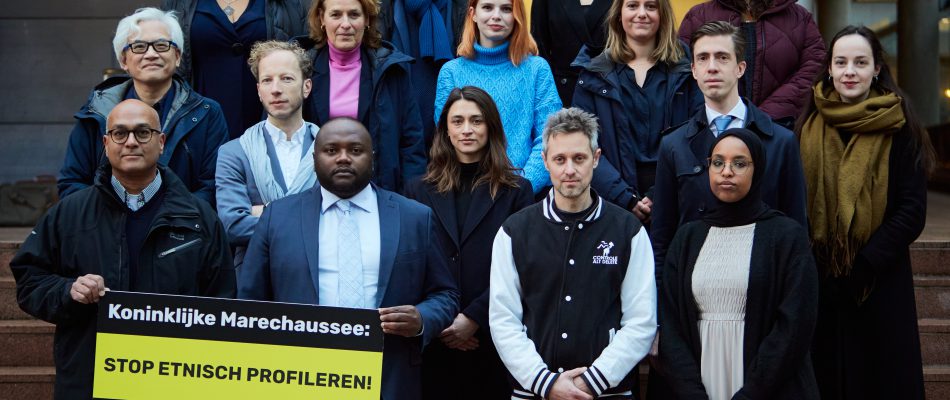
Today, December 8, 2022, the appeal in the lawsuit against ethnic profiling by the Royal Military Police (KMar) was filed. The coalition against ethnic profiling demands that the KMar stop using ethnicity in risk profiles and selection decisions at border controls. The Hague Court of Appeal must rule on the matter. There were three notable moments during the hearing today.
KMar wants to continue using ethnicity
Shortly after the court’s earlier first instance ruling, in 2021, the Royal Military Police said in the House of Representatives, “The guiding principle is that the KMar does not want to use ethnicity as an indicator within profiles or selection decisions.” At today’s hearing, the KMar reiterated this position, emphasized that they do not want ethnic profiling and confirmed that discrimination has serious consequences.
Nevertheless, the KMar stated during the hearing today that they want to continue to use ethnicity, including skin color, in checks. The lawyer representing the Royal Military Police said, “The KMar disputes and continues to dispute that there would be unlawful conduct, in that in the context of MTV [Mobile Security Surveillance] ethnicity can be used under conditions as one of the indicators of selection decisions.”
Dagmar Oudshoorn, director of Amnesty International Netherlands: “This means that the KMar still wants to be able to carry out checks partly based on someone’s ethnicity. The position of the KMar during the appeal cannot be reconciled with its commitment in the Lower House.”
Checking for nationality leads to checking for ethnicity
The Kmar emphasized that they include nationality in risk profiles, not ethnicity. The coalition against ethnic profiling shows that in practice this leads to ethnic profiling. After all, until you have seen someone’s passport, Kmar employees do not know which country someone is a citizen of, which nationality someone actually has. In practice, when the Kmar is looking for Nigerians smuggling money or, say, Vietnamese climbing into trucks, the Kmar will select people they think look Nigerian or Vietnamese. There is no such thing as a “Nigerian” or “Vietnamese” appearance. If you select people partly because of their presumed nationality, then in practice you are discriminating on ethnicity. That is ethnic profiling and therefore prohibited.
Dionne Abdoelhafiezkhan of Control Alt Delete: “Appearances, including skin color cannot and should not be an indication of someone’s nationality. That is discrimination.”
Powerful statements from concerned citizens
The court ruled in 2021 that a person’s skin color “may be an objective indication of a person’s alleged nationality” and thus be relevant to whether a person has a valid residence permit in the Netherlands. Mpanzu Bamenga, one of the two citizens who is a co-plaintiff in the lawsuit, told the Court of Appeal today that this ruling “caused him and millions of Dutch people grief, pain and indignation.” He called on the Court to comply with the Constitution. The other citizen plaintiff in this lawsuit, Robby Gobardhan, told the Court, “I stand here today because I don’t want to be discriminated against again. I also stand here today for all other non-white citizens who are being ethnically profiled again and again.”
The Hague Court of Appeal will rule on Feb. 14, 2023.
Read more about the case here. Here is a direct link to the statement of grievances and to the oral argument on appeal.